

Most ads fail. Not because the product is bad, but because the copy is weak. The right words can turn a “meh” scroll into a click, a sale, a loyal customer.
And here’s the sweet part,
You don’t need to be a professional copywriter to write ad copy that sells. What you do need is proven frameworks used by top marketers to get attention, build desire, and drive action through their psychological effects..
Today, I’m going to share seven of the most effective copywriting frameworks you can start using right now, plus examples, when to use each, and tips so you don’t sound like everyone else.
What Is A Copywriting Framework?
A copywriting framework is simply a repeatable formula that guides how you structure your message so it persuades people to take action.
Think of it like a blueprint. Instead of starting from a blank page and guessing what to say, a framework gives you a proven order: what comes first, what comes next, and how to close strong.
Why does this matter? Because human psychology is predictable.
People tend to respond to certain triggers in a sequence: they notice something → they get curious → they start wanting it → then they act. Frameworks are built around these natural patterns of behavior.
Here’s what makes a copywriting framework powerful:
- It saves time: no more writer’s block or staring at a blinking cursor.
- It increases consistency: your messaging feels solid. Top growth marketers and digital strategists use it to structure persuasive messaging across ads, landing pages, and content.
- It’s testable: you can run the same idea through different frameworks and see which version resonates most.
- It’s universal: whether you’re selling clothes in Lagos, SaaS in New York, or courses on TikTok, the psychology behind these frameworks works everywhere.
At the end of the day, a framework doesn’t write the copy for you; it gives you a skeleton. The flesh, personality, and style come from your brand voice and deep understanding of your audience.
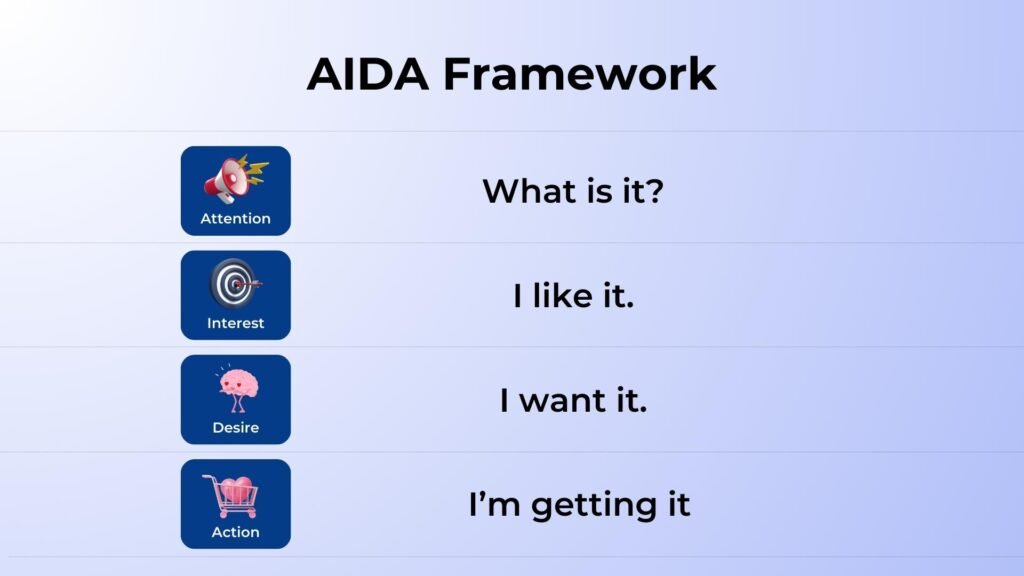
1. AIDA (Attention → Interest → Desire → Action)
What it is / When to use it
If you’re writing ads where people don’t know you, this framework helps you lead them from curiosity to purchase. Classic, reliable.
Structure
- Attention: A hook. Something surprising, bold, provoking.
- Interest: Flesh out the problem or a scenario they care about.
- Desire: Show benefits – what life looks like with your product/service.
- Action: Clear call to action (buy, sign up, click, message).
Example
2. PAS (Problem → Agitate → Solution)
What it is / When to use it
Great when your audience already has a problem, but maybe they don’t feel the urgency or understand the cost of not fixing it.
Structure
- Problem: Identify the issue.
- Agitate: Amplify it. Make them feel the pain.
- Solution: Introduce what solves it.
Example

3. Before-After-Bridge (BAB)
What it is / When to use it
Powerful for transformations. Use it when you want to paint “life before” vs “life after,” then show how your product bridges them.
Structure
- Before: Where your audience is now (pain, frustration).
- After: How life is with the problem solved.
- Bridge: How your product/service gets them there.
Example

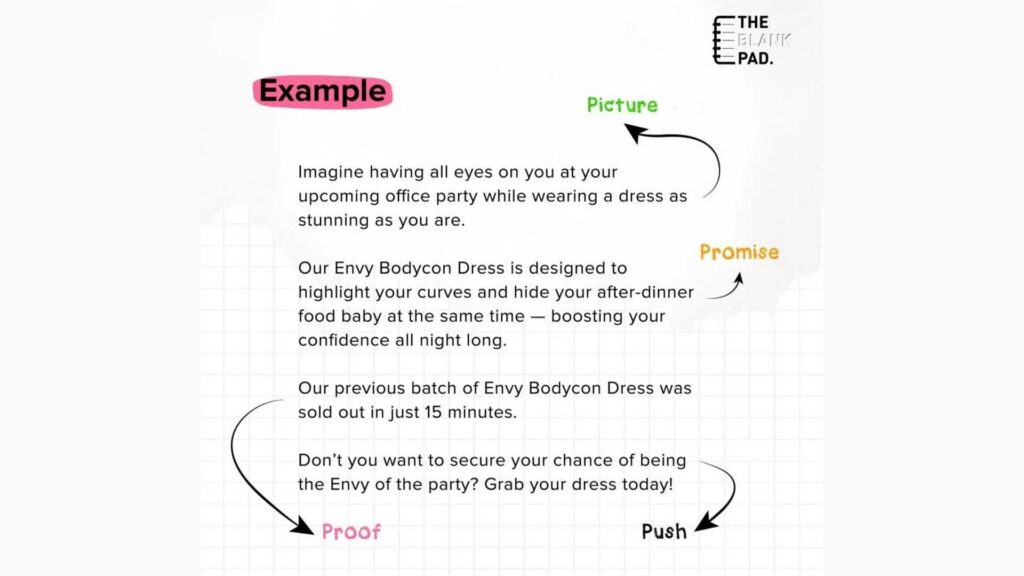
4. Picture-Promise-Prove-Push
What it is / When to use it
When you need to build trust and credibility, especially for higher price or less known offerings.
Structure
- Picture: Paint a vivid ideal scenario.
- Promise: What you will deliver.
- Prove: Testimonials or numbers or reasons to believe.
- Push: A final nudge (urgency / offer).
Example
5. Star-Story-Solution
What it is / When to use it
Narrative sells. If you can tell a relatable story (customer, founder, someone), it draws people in emotionally before you hit them with the solution.
Structure
- Star: The protagonist (customer, brand, founder).
- Story: The journey / conflict / struggle.
- Solution: How they overcame it via your product or service.
Example

6. PASTOR (Problem → Amplify → Story → Transformation → Offer → Response)
What it is / When to use it
Deeper than PAS; good if you have space (landing page, longer ad, email) where you want to build more emotion, trust, credibility.
Structure
- Problem: What your audience is up against.
- Amplify: Why it matters — what’s at stake.
- Story: Share something relatable or testimonial.
- Transformation: Show what life looks like after the change.
- Offer: What you want them to do.
- Response: Call to action.
Example
7. The Four C’s (Clear, Concise, Compelling, Credible)
What it is / When to use it
It’s less a full ad structure, more a checklist that makes every piece of your copy much stronger. Use this every time you’re writing.
Elements / Guidelines
- Clear: The reader should immediately understand what you’re offering.
- Concise: No fluff. No extra words.
- Compelling: Emotion, benefits, something that pulls them in.
- Credible: Proof, testimonials, numbers, factual statements.
How to Pick the Right Framework for Your Ad
Frameworks are tools, not rules. Knowing them is good; using them smartly is what counts.
- Match framework to goal: Want awareness → go AIDA. Want conversions or action → PASTOR, Before-After-Bridge, Picture-Promise-Prove.
- Know where your audience is in the funnel: If people don’t know you, you need more education + trust. If they know, you can push them more direct.
- Don’t overstuff: Pick one primary framework and maybe borrow an element of another.
- Test: Write two or three versions using different frameworks and compare what speaks more. Track clicks, conversions, cost.
- One practical way to choose the right framework is to study patterns from high-performing marketing campaigns and adapt those insights to your audience, funnel stage, and business goals.
Real Tips to Make These Frameworks Hit
- Use language your audience speaks: tone, slang, and style.
- Find strong hooks: questions, fears, bold claims. “What if ___?” “Tired of ___?” “The secret to ____?”
- Use benefits over features: people care about what your product does for them, not what it has.
- Be specific: “reduce acne by 70%” beats “helps with acne.”
- Add social proof: real people, quotes, before-after photos.
- Include urgency/scarcity when genuine: “limited spots,” “ends tonight,” etc.
Example: Same Product, Different Frameworks
Let’s imagine the product is “DataMax”: a mobile data plan that gives you more browsing hours at a cheaper rate.
Here’s how the same product can be pitched using different frameworks:
| Framework | Copy Example |
|---|---|
| AIDA | “Tired of your data disappearing before the month ends? Imagine streaming, browsing, and chatting without constant top-ups. With DataMax, get double the data for the same price. Dial 123# to switch today.” |
| PAS | “Frustrated that your 10GB data finishes in just one week? Money that should solve important needs just constantly leaks away. With DataMax, you enjoy affordable bundles that actually last — no more panic when YouTube buffers.” |
| Before-After-Bridge | “Before: you’re scared to open Instagram because your data won’t survive. After: you scroll, stream, and binge guilt-free. Bridge: DataMax gives you the freedom with bundles that last longer.” |
| Picture-Promise-Prove-Push | “Picture this: you make a data subscription this month, binge-watch your favorite series, and don’t have to subscribe for the next 3 months. Promise: DataMax doubles your browsing time at no extra cost. Prove: 200,000 Nigerians already switched and are saving weekly. Push: Join them today — dial 123# now.” |